
Background
New World Screwworm (NWS) is a type of fly whose larvae infest and feed on the living tissue of warm-blooded animals, causing severe wounds and, if left untreated, death. Although NWS was eradicated from the United States in 1968, a rise in cases in Central America during 2023 and 2024 has led to its detection in Mexico.
NWS remains endemic in South America and the Caribbean. In 2023, containment efforts in Panama failed, and the parasite spread through every country in Central America and into Mexico, raising the risk of reintroduction and establishment in the U.S.
The USDA is working closely with Mexican authorities to contain the outbreak and prevent the fly from spreading to the U.S. If reintroduced and established, NWS could lead to billions of dollars in losses due to treatment costs, animal deaths, and control efforts.
As of January 27, 2026, New World screwworm has been confirmed in northern Mexico, including the state of Tamaulipas, about 200 miles south of the U.S. border. Earlier detections tied to the same outbreak were reported in Sabinas Hidalgo, Nuevo León, in late 2025—less than 70 miles from the border. While these cases indicate a northward spread within Mexico and have led to increased public health and agricultural monitoring, there is no evidence of an established infestation in the United States at this time.
Current Situtation in the US
On June 3, 2026, the U.S. Department of Agriculture (USDA) Animal and Plant Health Inspection Service (APHIS) confirmed the first U.S. detection of New World Screwworm (NWS) in a three-week-old calf in Zavala County, Texas. Since that initial detection, additional cases have been confirmed in both Texas and New Mexico.
As of June 15, 2026, USDA APHIS had confirmed 12 animal cases of NWS in the United States. The Texas Animal Health Commission has issued movement restrictions for affected areas and maintains a live infested-zone map. USDA and state animal health officials continue surveillance, response, and containment efforts to prevent further spread.
While the detections in Texas and New Mexico are significant, state and federal animal health officials are actively monitoring the situation, maintaining movement controls, and conducting response activities to contain the outbreak.
Animal owners and veterinarians should remain alert for signs of NWS and report any suspected cases immediately to the State Veterinarian’s Office.
Interactive Maps
- Confirmed Detections of New World Screwworm | APHIS
- The snapshot of the map below was last updated on June 6, 2026 or click to view USDA’s most recent version.

The Panama-United States Commission for the Eradication and Prevention of Screwworm (COPEG) is a joint effort between the U.S. and Panama, reflecting the shared commitment to controlling this devastating pest. COPEG plays a crucial role in the ongoing effort to control and prevent the spread of NWS in livestock.
Get COPEG updates on NWS below:
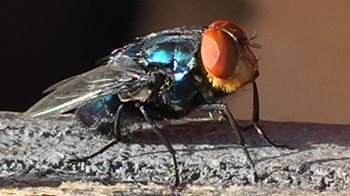
NWS fly
Adult flies resemble houseflies but can be distinguished by:
- Bright orange eyes
- Metallic blue-green body
- Three dark stripes on the back
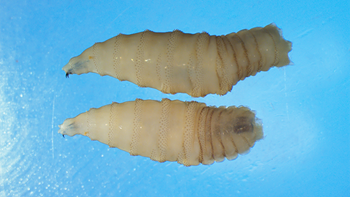
NWS larvae
Key indicators of NWS infestation include:
- Larvae in wounds or body openings (e.g., nose, ears, umbilicus, genitals)
- Egg masses near wound sites
- Foul-smelling discharge (bloody or purulent)
- Wounds that progressively enlarge or deepen
- Behavioral signs: head shaking, rubbing, isolation, irritability, reduced appetite
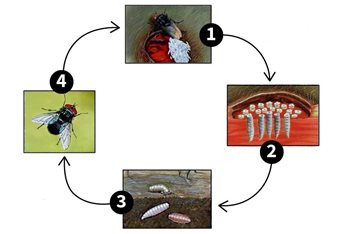
NWS life cycle
What to do if you suspect NWS
- Contact WSDA animal health officials
- ahealth@agr.wa.gov
- (360) 902-1878
- Contact USDA-APHIS
- Veterinarian in charge by state
- After-hours line: (866) 536-7593
- Follow USDA-APHIS protocols in the "Guidance and response plans" below.
- Collect larvae from multiple wound sites using gloves and forceps.
- Place in 70% alcohol inside a tightly sealed vial.
- Submit samples with a completed Parasite Submission Form to the National Veterinary Services Laboratories.
- Quarantine the animal(s) immediately to prevent further spread.
- NWS is ruled out or confirmed.
- Appropriate treatment is completed.
- The supervising veterinarian verifies the animal is screwworm-free.
Animal treatment
- Remove all visible eggs and larvae.
- Clean and disinfect the wound.
- Provide analgesics as appropriate.
- Apply effective topical or systemic antiparasitics.
- Recheck the animal 24 hours later and retreat if any larvae remain.
All treatment must be performed under veterinary supervision. Use of gloves is advised for safety. There are no FDA-approved drugs for treating NWS. All antiparasitic use is extralabel and subject to FDA restrictions—especially for food-producing animals. Medicated feeds cannot be used extralabel. Refer to USDA protocols for specific antiparasitic recommendations for different species.
Environmental cleanup and control
To prevent reinfestation:
- Collect expelled larvae, place in sealed vials with alcohol, then bag and dispose in the trash.
- Apply approved larvicides to animal housing or quarantine areas.
- After spraying, wash surfaces with warm, soapy water to remove residues.
- Monitor premises weekly for one month post-quarantine.
Latest News
- 3/10/26 FDA Issues Emergency Use Authorization for Topical Spray to Prevent and Treat New World Screwworm in Multiple Species, Including Cattle, Sheep, Goats, Horses, Wild and Exotic Mammals, Wild and Pet Birds
- 3/09/26 USDA and U.S. Army Corps of Engineers Advance New World Screwworm Preparedness with New Texas Sterile Fly Facility Contract
- 2/18/26 FDA Issues Emergency Use Authorizations for Drugs to Treat New World Screwworm in Dogs and Cats
- 2/09/26 USDA Announces Completion of Sterile Fly Dispersal Facility in Texas
New World ScrewwormVeterinary ServicesWildlife Services - 2/05/26 FDA Issues Emergency Use Authorization for Over-the-Counter Injectable Drug to Prevent New World Screwworm in Cattle
- 1/30/26 USDA Shifts Sterile Fly Dispersal Efforts to Defend U.S. Border
- 1/21/26 USDA Announces New World Screwworm Grand Challenge
- 12/18/25 FDA Conditionally Approves Drug To Treat New World Screwworm in Dogs
- 12/04/25 FDA Conditionally Approves Topical Drug for Cattle for New World Screwworm and Cattle Fever Tick
- 11/21/25 USDA Launches Screwworm.gov, Centralizing New World Screwworm Information Across the Federal Government
- 11/14/25 Secretary Rollins Leads Largest USDA Trade Mission to Mexico, Participates in New World Screwworm Joint Reviews
- 11/14/25 USDA Announces Opening of Sterile Fly Dispersal Facility in Tampico, Mexico
- 10/17/25 USDA Update on Coordinated Federal Response to Protect United States from New World Screwworm
- 10/17/25 USDA Shares New World Screwworm Response Playbook
- 9/22/25 Mexico Confirms Case of New World Screwworm in Nuevo Leon
- 8/26/25 HHS and USDA Confirm Singular Traveler-Associated New World Screwworm Case; Precautionary and Proactive Surveillance Ongoing
- 8/15/25 USDA Announces Sweeping Plans to Protect the United States from New World Screwworm
- 7/09/25 Secretary Rollins Takes Decisive Action and Shuts Down U.S. Southern Border Ports to Livestock Trade Due to Further Northward Spread of New World Screwworm in Mexico
- 6/30/25 USDA Announces the Phased Reopening of Southern Ports for Livestock Trade
- 6/26/25 APHIS To Hold Listening Sessions on New World Screwworm Technologies and Tools
- 6/18/25 Secretary Rollins Announces Bold Plan to Combat New World Screwworm’s Northward Spread
- 5/28/25 Update on USDA Efforts to Fight New World Screwworm in Mexico
- 5/11/25 Secretary Rollins Suspends Live Animal Imports Through Ports of Entry Along Southern Border, Effective Immediately
More...
Guidance and Response Plans
- USFDA:
- USDA-APHIS:
Resources
- CDC
- USDA-APHIS:
- Utah Dept. of Agriculture and Food:
Contact us:
WSDA Field Vet Regions
Washington State Department of Agriculture
Animal Health Program
PO Box 42577
Olympia, WA 98504-2577
Phone: (360) 902-1878
24/7 Entry Permit Line: (800) 942-1035
Fax: (360) 902-2087
Email: ahealth@agr.wa.gov